
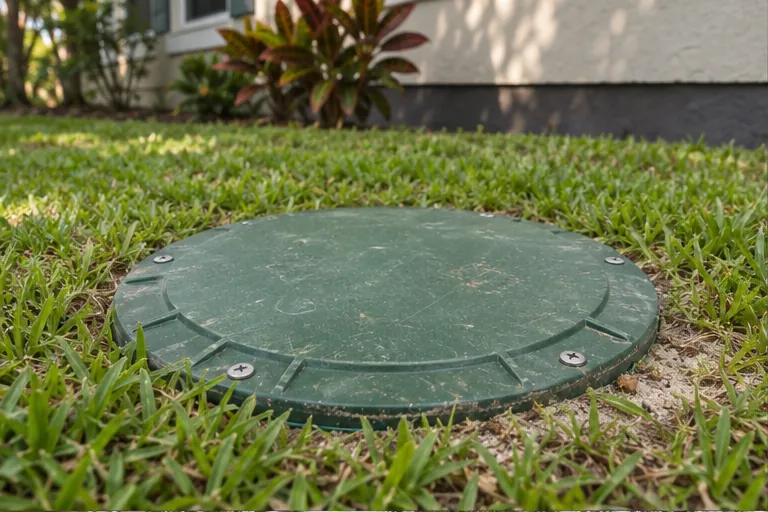
Septic flow testing: scope, access and written results
Find out where the water will be observed, what will be measured and what the result can tell you about this house.
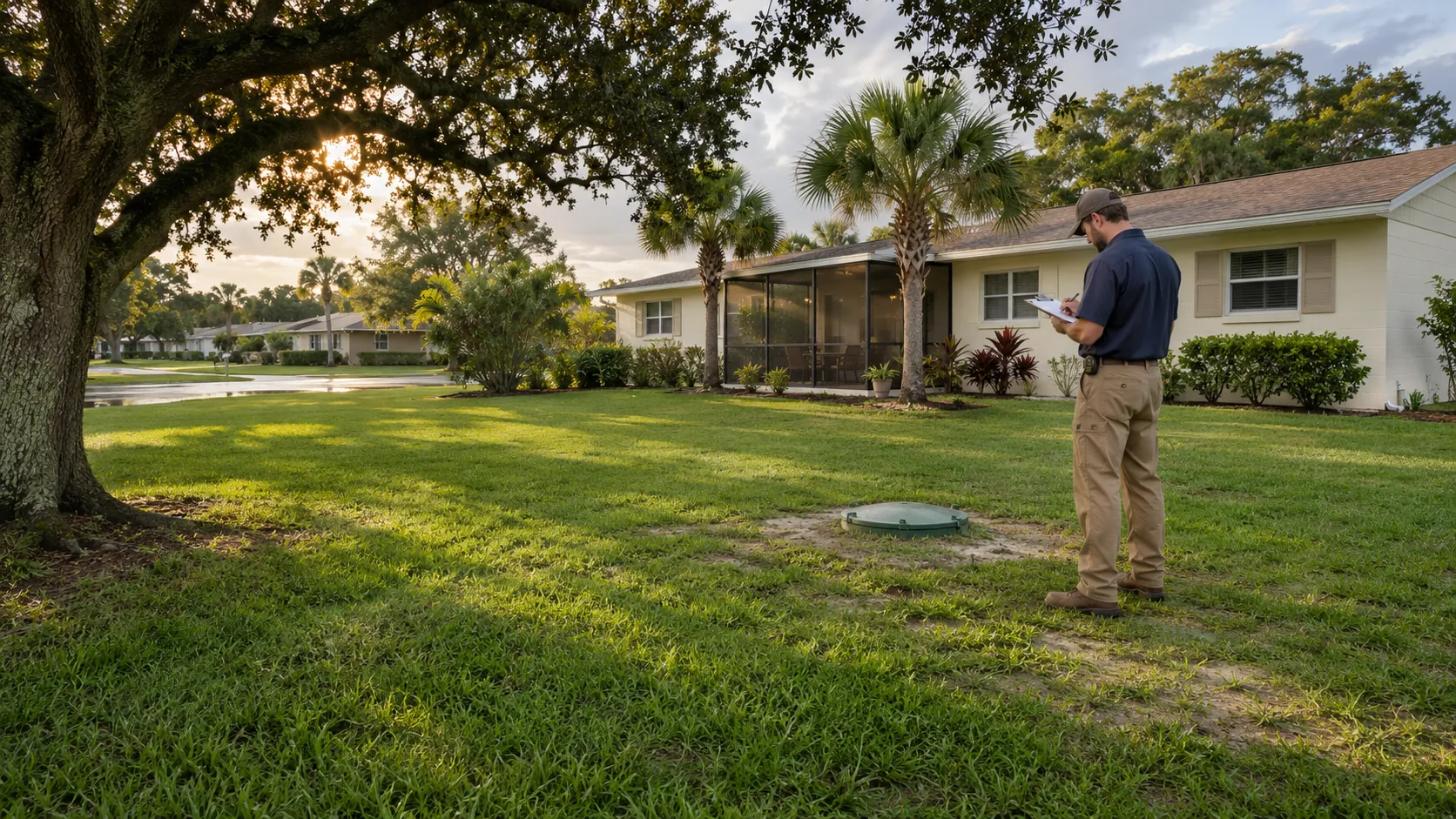
Buying a house with a septic tank? Find out where the water goes, what a flow test can show, and what belongs in the written report before closing.
We connect you with independent providers. The evaluator confirms the scope, price and appointment with you.
Tell us what you need checked at the property.
Water disappears down the kitchen sink. Where did it go? In a conventional septic system it enters a tank, where solids settle. Liquid leaves through the outlet and spreads into a drainfield, where soil does much of the treatment. A person standing at the sink can see the first part of that trip. An inspector who can locate and examine the tank and field can tell you much more about the rest. See EPA’s diagram of a conventional system.
“Flow test” can describe several different visits. Someone might run fixtures and watch for a backup, or a specialist might measure water delivered to the absorption area and observe how it responds over time. Ask where the provider will observe the water, how they will measure it and what they will put in writing. Those three answers tell you more than the name on the quote.
Consider a house that sat empty all summer. Its drainfield has had months without morning showers or laundry. Now imagine a house occupied by four people right up to inspection day. A dry lawn and freely draining fixtures carry different weight at those two homes. Give the inspector the last occupied date and the date of the last pump-out, even if all you know is “before the listing photos.” The uncertainty belongs in the report.
For scale, EPA says indoor water use in a typical single-family home can reach 70 gallons per person in a day. At that rate three occupants would use 210 gallons across the day. A single running toilet can waste up to 200 gallons on its own. Ask about the guest-bath toilet that runs whenever the handle sticks. That one small detail can matter more than the number of bathrooms on the listing. These figures illustrate household loads. The professional sets any test volume from the property and the method. EPA water-use figures.
| What brought you here | What to request |
|---|---|
| A purchase contract mentions a septic inspection | Send that paragraph to the evaluator. Ask for an itemized scope and a signed report that identifies any exclusions. |
| A toilet gurgles and wastewater backs up | Describe the active symptoms when you call. Get a professional diagnosis before introducing additional water. |
| You plan to add a bedroom or change the building’s use | Give Brevard Environmental Health the existing permit and proposed floor plan. Ask which review the change requires. |
| You want to build on vacant land | Request a site evaluation for permitting. Soil, topography and the proposed building matter here. There is no installed system to flow-test. |
| The file lists an aerobic treatment unit | Contact the approved maintenance entity that maintains that unit. Ask for its service records and the appropriate evaluation. |
Florida has a specific procedure for voluntarily evaluating an existing system. It covers a tank inspection, a drainfield inspection and a written assessment unless the person requesting it specifies omissions in writing. Pumps and alarms have their own checks where present. Active failure, proposed increases in sewage flow and changes in wastewater characteristics follow a different route. For an aerobic or performance-based system, the maintenance entity handles the evaluation. Florida’s applicable rule. State permitting guide.
See the scope of a flow test · Compare a homebuyer evaluation
Ask the seller for a recent utility bill and read the line items. A charge for city water tells you where the water in the shower came from. The sewer charge, the utility account and the tank abandonment record tell you where it goes afterward. Those details can save you the price of sending a septic evaluator to a home that already sends its wastewater down the street.
The city counted roughly 1,066 developed parcels with a sewer line available but no connection on October 1, 2023. Its mandatory-connection page also describes more than 32,000 existing septic systems across Palm Bay. The first figure concerns one subset of properties on a particular date. It explains how a seller can truthfully say “there’s sewer on our street” while the house still uses its drainfield every day. The figures are planning data. Your parcel may have changed since the count. Palm Bay’s connection figures and phased notice process.
| What you have | What it establishes | What to get next |
|---|---|---|
| A sewer line on the city map | The city shows infrastructure or availability near the property. | Ask Utilities whether this account actually uses sewer. |
| A septic permit and site sketch | A system was permitted at the marked location. | Find the most recent repair, modification or abandonment record. |
| A written notice to connect | The utility has taken action specific to this address. | Ask for the notice date, current status and any outstanding work. |
| A pump-out receipt | A contractor removed material on a particular date. | Ask whether anyone inspected the tank and field, and request the findings. |
Start with the city’s utility availability lookup. If you use a mailing address with a directional suffix, include it. Obtain the parcel ID from the Brevard County Property Appraiser before calling about an ambiguous result. For Palm Bay utilities, the city lists (321) 952-3420. For historical septic records, Brevard Environmental Health links its permit archive and search instructions. Keep both answers with the contract paperwork. A map and an inspection report answer different questions about the same home.
The drainfield needs soil that can accept and treat the water leaving the tank. When the soil is already saturated, adding water changes the stakes. The most useful clue can be the seller’s own timeline. Did the toilets slow after three days of rain? Did they recover when the yard dried? Did the same thing happen while the house was occupied, or was the water turned off between showings?
| Period | Typical precipitation | Why ask about it? |
|---|---|---|
| February | 2.42 inches | A dry visit may follow weeks without the water levels occupants see in summer. |
| June through September | 29.26 inches combined | These four months account for about 53% of the annual normal. |
| September | 7.95 inches | The monthly normal is about 3.3 times February’s. |
| Full year | 55.55 inches | A citywide weather reference, with actual rainfall and drainage varying by lot. |
We added NOAA’s June, July, August and September normals for station USC00086761 and divided by its annual normal. That calculation describes the local rainfall pattern. It cannot tell an evaluator the groundwater depth beside your tank, whether Tuesday’s puddle came from a downspout or whether the field can accept another bedroom’s wastewater. Ask the evaluator to write down the ground conditions, recent water use and any part of the system they could not assess. NOAA’s Palm Bay station tables, precipitation section.
If floodwater is standing over an active field, put the test on hold and contact a qualified professional. EPA advises against pumping a tank while the surrounding field is flooded or saturated. Outside water pressure can lift an emptied tank and damage its connections. Keep people and vehicles away from contaminated ground. Tell the office what the yard looks like before anyone travels to the property. EPA’s guidance for flooded septic systems.
Both bars use the same scale. The station normal gives a useful comparison when you ask about recurring wet-season symptoms.
Find out where the water will be observed, what will be measured and what the result can tell you about this house.

A buyer’s guide to Florida’s voluntary evaluation, Brevard permit records and the two questions to settle before your inspection deadline.
Compare published Brevard inspection ranges, identify hydraulic testing add-ons and get an itemized quote for the right property.
Tell the provider what the buyer or lender needs in writing and by what date.
Ask the seller for the pumping ticket before authorizing another truck. A dated ticket might identify capacity and condition or it might simply say how many gallons the hauler removed. Those entries answer different questions. A tank that was only partly emptied can yield fewer gallons than its rated capacity. An invoice for hauling alone says little about the condition of the outlet, the lid or the soil downstream.
Under Florida’s voluntary procedure the inspector may waive the pumping step if there is qualifying documentation from the previous three years. It must document pumping or a permitted installation, repair or modification, give the tank capacity and record that its condition does not create a sanitary nuisance. The inspector decides whether it qualifies. Have them identify the record they accepted and what they could actually see during this visit. Read the tank inspection provisions.
A Brevard pricing guide publishes $300–$500 for an inspection that includes pumping. Another gives $150–$550 across several inspection scopes and lists a hydraulic load test as an extra. Those numbers buy different things. Neither publisher gives a standalone fee for measuring your field’s response. Ask the contractor to price that line explicitly, including any return trip.
As a buyer, put each quote beside the lender’s request. A cheaper fixture check can leave you paying for a second appointment if the lender asked for tank condition and a signed field assessment. Brevard Septic Services and Brevard Septic publish the comparison figures.
Picture a buyer turning on a shower during the final walk-through. The water disappears, the floor stays dry, and the seller says the tank was just serviced. All three things can be true while the buyer still has no idea whether water reached the drainfield. Before booking a test, find out which part of the system you need someone to see.
A family taking showers, washing clothes and cooking puts a different demand on a system from an agent showing an empty house twice a week. Write down when the home was last occupied full-time, roughly how many people lived there and when someone last used the plumbing. Give the inspector the dates, even if they are approximate. A report written after months of vacancy should say so. Otherwise, the next person to read it can easily assume the system was handling everyday use right up to the inspection.
Look for the service ticket from the last pump-out. Did the contractor record the liquid level before removing anything? Does the ticket identify the tank’s capacity, which compartments were opened or what the technician saw inside? A clean tank can let an evaluator see walls that were hidden. It can also hold water introduced during a brief fixture check before any of that water reaches the outlet. Ask for the starting level, where the water was introduced and where the inspector saw it arrive.
Florida’s voluntary inspection procedure spells out what belongs in the tank and drainfield portions and how omissions are recorded. Send the original ticket to the evaluator before you pay for another pump-out. They can tell you which observations are usable, whether the documentation meets the procedure and what is still missing.
One Palm Bay homeowner described discovering that a kitchen sink still drained to a tank after they understood the house had been converted. That is a reason to check the records, even on a street with utility service. Start with the city’s utility service availability lookup. Then ask Utilities which wastewater service the account actually receives. If someone says a conversion happened, ask for the connection and septic abandonment records for the parcel. Street availability, water service, an old tank on site and an active sewer connection answer four different questions. The homeowner’s account in r/321.
In a Brevard homebuyer discussion, the buyer was trying to reconcile two opinions on the same property. The tank’s condition was disputed while the original drainfield finding was favorable. If two reports in your file sound like opposites, lay them side by side. Under each one, write down the parts inspected, the defect reported and the evidence behind it. A cracked tank wall and a field accepting water are perfectly compatible observations. A third estimate for an entire system will tell you little until you know which observation actually needs checking. The Brevard buyer’s account.
| What you have | What to request next |
|---|---|
| An invoice for pumping | The technician’s observations and the signed assessment, if one was ordered. |
| A report that says fixtures drained | The test point, starting conditions and whether the inspector observed the field. |
| A seller’s photo of a wet yard | The photo date, location relative to the field, weather and any indoor symptoms that day. |
| A proposed replacement | The component identified, evidence of failure and a separate, written repair scope. |
Keep the photos, service tickets and reports together. If the family moves in and the first backup follows a weekend of laundry, those records give the responding contractor a starting point. They also let a buyer or seller ask a precise question while there is still time for a useful answer.
A homeowner sometimes hears “the tank was full” and pictures a barrel ready to overflow. A working gravity tank normally holds liquid up to its outlet. Ask where the level sat in relation to the outlet, whether anyone had already pumped, and what the evaluator saw happening downstream. A record of the starting condition makes a later observation much easier to interpret.
Look for a sketch or description that gets you from a fixed feature of the house to the field. Read how the inspector established its location, whether the soil showed ponding and where roof or yard drainage goes. A seller who describes a wet spot by the fence may be pointing to a different part of the lot. Put that observation on the same sketch before deciding what to investigate.
“Field inaccessible behind fence” gives you a concrete job. Get access or ask how the limitation affects your decision. “Condition satisfactory” without an inspection scope leaves you guessing. Find the date, signature, components covered and any maintenance recommendations. Get clarification while the site conditions are fresh and the people who saw them can explain. See Florida’s sample report.

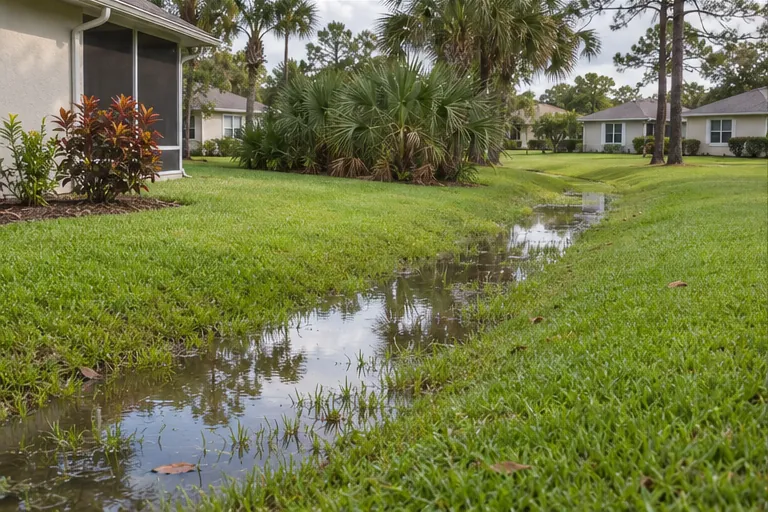
If water covers the drainfield or sewage is coming back indoors, describe it immediately when calling. Keep people and pets clear of sewage, reduce water use and leave the tank cover alone. EPA cautions against pumping a tank while its field is flooded or saturated. In high groundwater an empty tank can lift and break its connections. The evaluator can decide when safe access and meaningful observations are possible. EPA guidance for flooded systems.
For an inspection booked after a storm, take a photo from a dry spot and note the date, the first fixture affected and when household drainage returned. Tell the evaluator whether this happens after every heavy rain or this is the first event. A photo gives them something specific to compare with the site plan and their own observations once the water recedes.
A buyer finds a problem and asks the seller for a drainfield replacement allowance. Before either side settles on a number, check the sewer address again. A connection notice or available main can change which work makes sense. In areas without a feasible sewer connection, a different program may help with an advanced treatment system. A plumber’s quote, a septic evaluator’s observations and the county’s written funding decision each belong in the file.
For its Quick Connect program, Brevard describes a calculation of $1,600 for each estimated pound of nitrogen prevented from reaching the lagoon, subject to program limits. Its published caps are $12,000 for a gravity connection without a pump and $24,000 for a qualifying connection that needs a pump or uses a force main. Those amounts are caps on eligible work. A buyer cannot subtract the maximum from a contractor’s price and call the difference the closing cost. Ask the utility about availability and capacity, identify the parcel on the county map, and wait for the county’s written amount and permission to proceed before scheduling work under that grant. Brevard Quick Connect rules · County septic and project maps.
The county identified 4,496 properties within 30 feet of existing sewer infrastructure in its detailed analysis, yet its plan earmarked 876 of the higher-loading opportunities for these connections. Distance is only part of that calculation. A measured flow observation on one afternoon cannot establish nutrient loading or grant eligibility. It can help document how the system responded that day while you gather the utility and funding answers in parallel. How Brevard selected sewer projects.
A blank search can mean the record is indexed under a block, subdivision or older permit number. Here’s how to follow the parcel and recognize the document you need.
A recent pump-out leaves space below the tank outlet. For a vacant Palm Bay house, ask where the inspector can observe water beyond the tank.
Septic testing after heavy rain starts with the yard. Tell the evaluator where water stood, which fixtures backed up and whether the house lost power.
A county line, utility boundary and postal city can describe three different areas. Select the guide closest to the property, then confirm connection and service availability by address.
Ask for the inspection scope before approving a pump-out. A fixture flow observation can be quoted by itself. A full Florida voluntary tank evaluation normally includes pumping and examining the tank, with a limited documented exception. The original water level matters, so tell the evaluator when the tank was last emptied.
Send the lender’s exact wording to the evaluator before booking. Ask the lender who may sign, what components must be examined and whether it requires a particular report. A short fixture check may leave a written requirement outstanding.
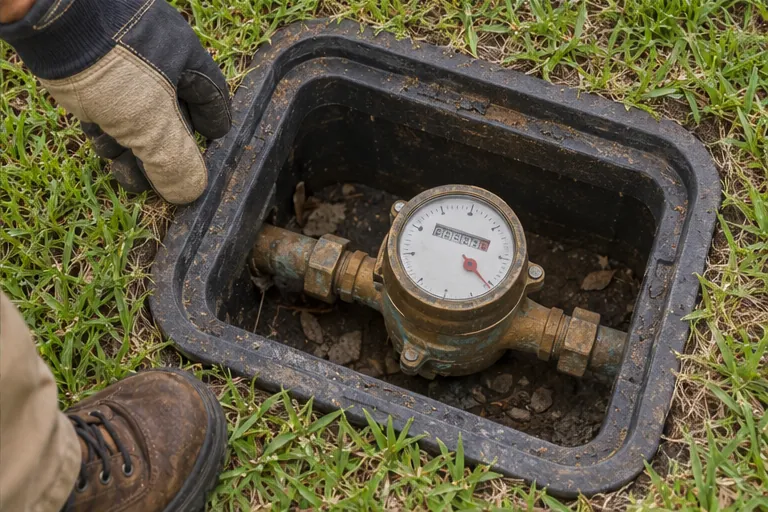
Water service brings water to the property. Wastewater service takes used water away. Ask Palm Bay Utilities for the connection status of the specific parcel, then compare it with the septic and abandonment records. A water meter alone answers only the first question.
Bring the last occupied date, last known pump-out date, permit drawing, and information about who can turn on water and grant access. Ask the evaluator how the vacancy changes what can be concluded about the drainfield.
Describe what you see before requesting a flow test. Stop adding test water, reduce household use and keep people and pets away from sewage. A provider can advise whether the immediate need is a malfunction or flood assessment and when a condition check can proceed.
Compare the total for the same scope. Some local advertised figures cover an add-on to a home inspection, while others include locating, pumping or a written report. The cost guide identifies the seller of each published example and the items to confirm on a written quote.
No. An addition can change the permitted design load. Supply the existing permit and the building plans to the permitting office. The office can identify the approval needed for the proposed occupancy and layout.
Palm Bay Septic Flow Test takes requests and can refer them to independent providers. The individual or firm you hire confirms the scope, qualifications, availability and fee, performs the work and signs any report.
Ask for separate scopes. A well-water sample goes to a laboratory to answer a drinking-water question. A septic evaluation looks at wastewater disposal. A result from one cannot answer the other.
Before booking a septic flow test, Palm Bay buyers can share the property address, closing date and question the report needs to answer.
